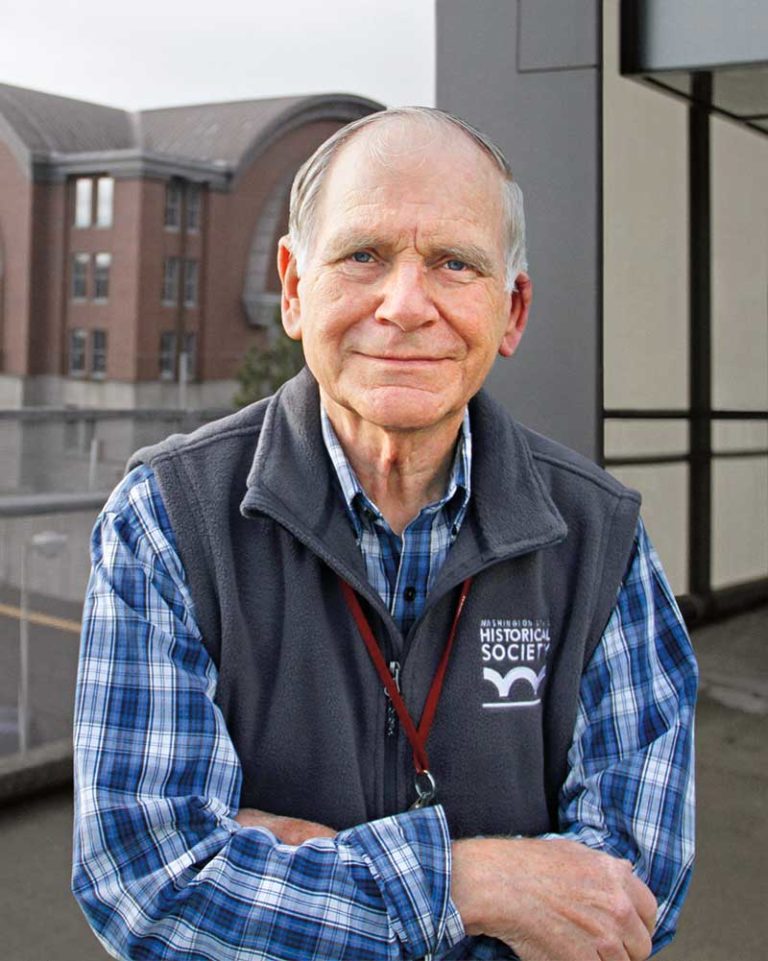
Melvin “Mel” Hamre ’54 lived life embracing a strong work ethic, a curiosity about the world, and a belief that education and learning not only better prepare us for the world but help us make a better world. He also loved Washington State University, and his belief and love for WSU drove his generosity to the university for more than forty years.
Hamre was born and raised in rural Edgewood, about eight miles east of Tacoma, WA, where his family literally hewed a section of timberland to carve out a farm where they raised animals and a large garden. His father also worked part-time as a logger, while his mother managed the household. To meet food demand during World War II, his family maintained 500 laying hens. Mel learned early the ethics and value of hard work, perseverance, and responsibility.
Were it not for a scholarship and the part-time job he had at the audio-visual center in the basement of Holland Library, Mel would not have been able to attend what was then Washington State College in 1950. As part of his job at the library, Mel spent weekends showing films for classes and groups of students. He soon became chief projectionist and assistant chief technician, earning one of the highest student wages at the time—$1 per hour (the equivalent of $13.00/hour today).
After graduating with a degree in agriculture and human and natural resource sciences, Hamre taught eighth-grade math and science for three years before serving two years in the U.S. Army, stationed in Germany, where he seized every opportunity to visit nearby European countries. After leaving the Army, he earned a master’s (’63) and a PhD (’66) in agricultural studies at Purdue University, followed by a position at the University of Minnesota in the Department of Animal Science and the Agricultural Extension Service. Specializing in poultry production and processing, he helped to build Minnesota’s program until he retired in 1995.
After retirement, Hamre moved back to the Pacific Northwest, near Tacoma, where he volunteered for 25 years at the Washington State History Museum and served as a member of the Tacoma Historical Society. And though he carved out a distinguished career at Minnesota and spent his retirement years near the Tacoma area, Hamre’s love of WSU lived in him throughout his life. He never forgot the fact that he would have never been able to obtain a college education had it not been for that WSU scholarship and the job he had at the library.
During his 40 years of giving to WSU, Hamre generously supported the College of Agricultural, Human, and Natural Resource Sciences (CAHNRS), including 4-H, the College of Education, Sport, and Human Sciences (CESHS), WSU Libraries, and the Jordan Schnitzer Museum of Art WSU. Understanding the financial needs of students from working-income families, Hamre established endowed funds for a scholarship at CAHNRS, as well as a scholarship at CESHS for teaching science, and endowed funds at WSU Libraries to supplement the wages of student workers and the acquisition of books and films—all helping generations of students forge promising futures and contribute to their communities.
In addition to earning his college and graduate degrees at land-grant universities and spending his career teaching and researching at a land-grant university, Hamre also visited the majority of our nation’s land-grant universities; WSU was always his favorite. When asked why, he replied, “Because I’m a Coug.”
And while Hamre passed away during the summer of 2025 at age 92, his planned gifts to CAHNRS, CESHS, WSU Libraries, and the Jordan Schnitzer Museum of Art WSU will have a lasting impact. Always a careful planner, he took advantage of multiple tax-wise giving strategies throughout the years, including gifts of appreciated assets, qualified charitable distributions (QCDs) from his IRA, and ultimately making the WSU Foundation a beneficiary of his estate plans.
Hamre believed deeply that all young people with talent and potential should have the opportunity for a college education. His love for and generosity to WSU is a testament to that belief and continues as an enduring legacy, making a WSU college education possible for generations to come.
To learn more about how you can create a blended gift strategy through both tax-wise lifetime giving and charitable estate planning, please contact Theresa Boyer at theresa.boyer@wsu.edu or 509-358-7584.