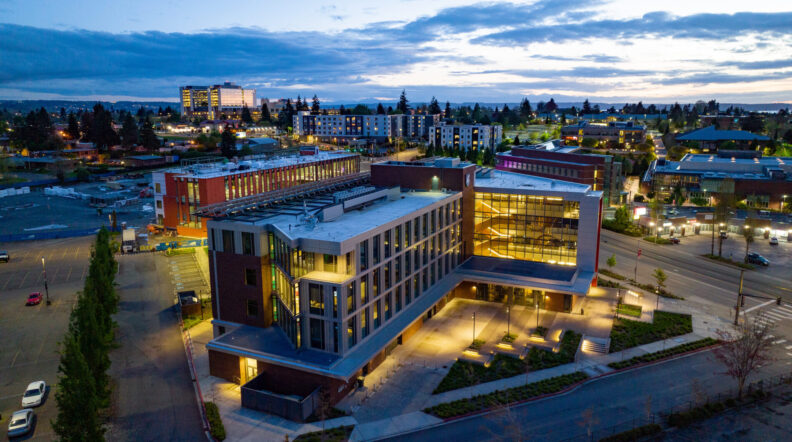
At Washington State University Everett, undergraduate research gives students the opportunity to move from learning about complex problems to actively tackling them. This year’s WSU Everett Student Research Award recipients are doing just that—pursuing innovative projects that span cybersecurity, machine learning, renewable energy, and medical analytics, while building skills that will shape their academic and professional paths for years to come.
Supported by faculty mentors and flexible research funding, these students are testing ideas, presenting their work, and gaining confidence as emerging leaders in a variety of exciting fields.
Yakup Atahanov: Making AI systems safer
Yakup Atahanov, a senior software engineering major from Turkmenistan, is focused on a problem most users never think about: what happens when an AI system has the keys to your computer. His research examines how large language models can introduce security vulnerabilities when granted different levels of system access, and how those risks can be identified before they reach users.
Atahanov helped develop JarvisOS, a research testbed built specifically to surface and analyze potential AI-related security issues. “Our goal is to build something secure, sustainable, and a much more robust system with the LLM still in it,” Atahanov said. He envisions JarvisOS as an open-source platform that continues to evolve—one that prioritizes long-term reliability over quick deployment.
The experience sharpened more than Atahanov’s technical skills. Working on a project with real-world implications pushed him to think like an engineer with responsibility for what he builds, not just curiosity about how it works.
Marcus Osborn: Advancing renewable power systems
Marcus Osborn didn’t set out to become a power systems researcher. A senior electrical engineering student from Snohomish, Washington, he arrived at the topic through an undergraduate exchange at Monash University in Melbourne, Australia, where he worked in a power engineering laboratory alongside graduate students. The experience reoriented his academic focus entirely.
Back at WSU Everett, Osborn continued the work we began in Australia, turning his attention to grid-forming inverter-based resources: technology that is becoming increasingly critical as renewable energy sources make up a larger share of the power grid. His research examines how these systems affect grid stability and what it takes to keep them reliable as renewable penetration increases.
Along the way, Osborn developed a host of skills, including project management, technical writing, and applied laboratory research. “This experience helped to shape my long-term goals of working in the power industry, as well as narrowing my field of study. Additionally, it had a profound impact on my course choices,” he said. “It has also given me the desire to go after a graduate degree, likely a master’s, and has given me a better impression and understanding of professional academics.”
Ferdusbanu Allakova: Securing the future of quantum computing
Most cybersecurity researchers spend their careers defending systems that already exist. Ferdusbanu Allakova, a junior cybersecurity major from Turkmenistan, is working on systems that don’t yet.
Allakova’s research focuses on quantum cloud security, simulating how multiple users share a quantum system and analyzing the interference, information leakage, and other vulnerabilities that emerge when powerful computing resources are shared. She chose the project deliberately. “Quantum computing is the future,” Allakova said, “and I want to understand how to protect systems before vulnerabilities become a bigger issue.”
The work required her to develop new technical fluency in Python and Qiskit while navigating complex problems largely on her own. That independence, she said, prepared her most, reinforcing her goal of building a career at the forefront of computing security.
Alex Martin: Leveraging data to inform medical research
Alex Martin came to his research project without two things most researchers consider essential: a background in eye physiology and any prior experience with hemodynamics. He took the project anyway.
Martin, a senior data analytics major from Everett, is applying computational modeling to understand how fluid flow behaves within the human eye, with potential applications in glaucoma treatment and cardiovascular imaging. The appeal lay in the intersection of data analytics and physics, applied directly to a medical problem affecting real patients.
Presenting that work publicly for the first time added another dimension. “The experience I gained made me a lot more confident to embark on future projects,” he said. “Working on research with potential medical applications also made me a lot more interested in the medical field in general, and I’m looking at graduate school options where I may be able to do a physics PhD with a medical focus.” The experience of standing behind his research—explaining it, fielding questions, defending his methods—proved as formative as the research itself, and has since led him to explore graduate programs where physics and health intersect.
Research that builds momentum
“Research elevates the student experience by connecting classroom learning to real issues and real challenges,” said Sandra Haynes, executive vice president for WSU statewide campuses. “It gives our students hands‑on experience, close mentorship with faculty, and the confidence they need to succeed in high‑impact careers.”
These four students approached different problems with different tools, but each found the support and resources necessary to take on something genuinely difficult through the Student Research Award. The challenges were technical, but the judgment, independence, and the ability to communicate complex ideas under pressure that they honed along the way will outlast any single project.
Gifts supporting the WSU Everett Student Research Award enable our students to pursue meaningful research, gain hands-on experience, and prepare for successful careers. To learn more about how you can support research at WSU Everett, please contact Hayley Larson, director of development, at hayley.larson@wsu.edu.