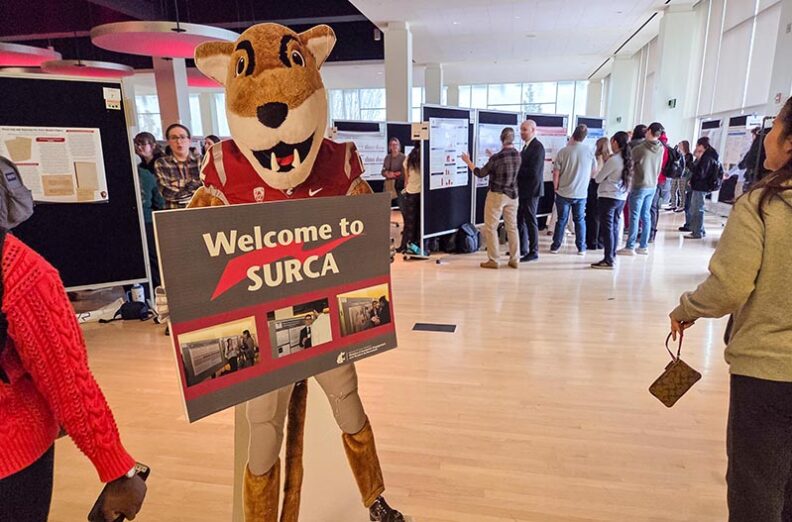
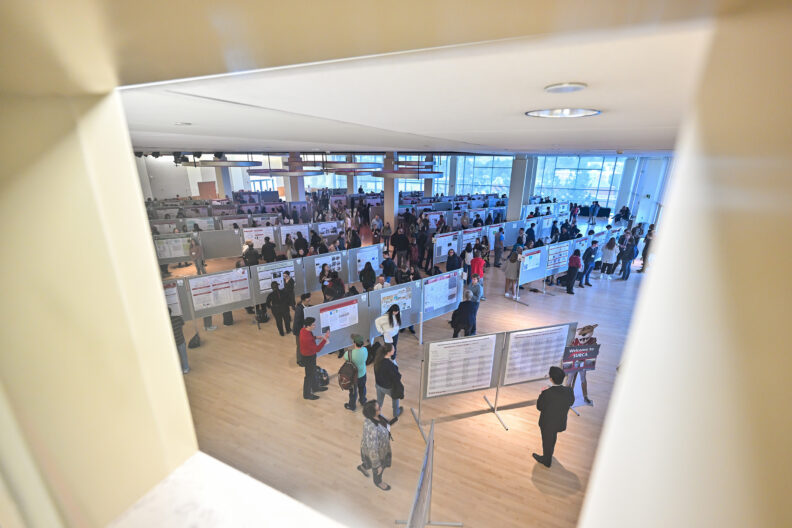
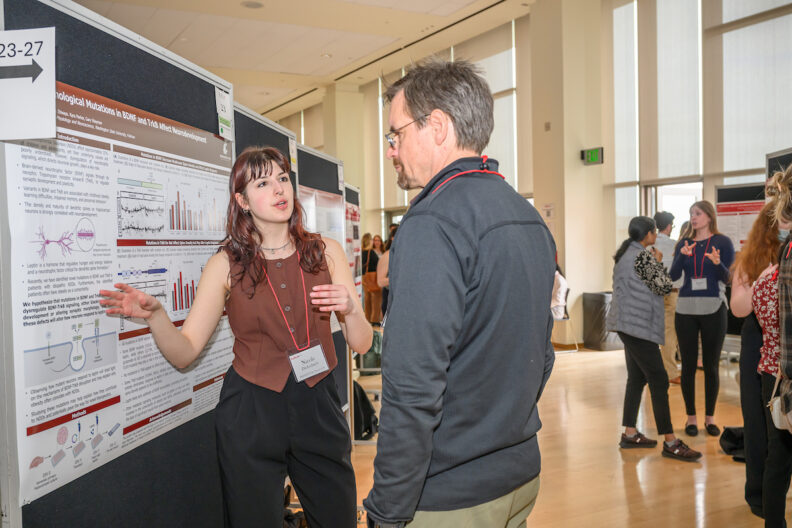
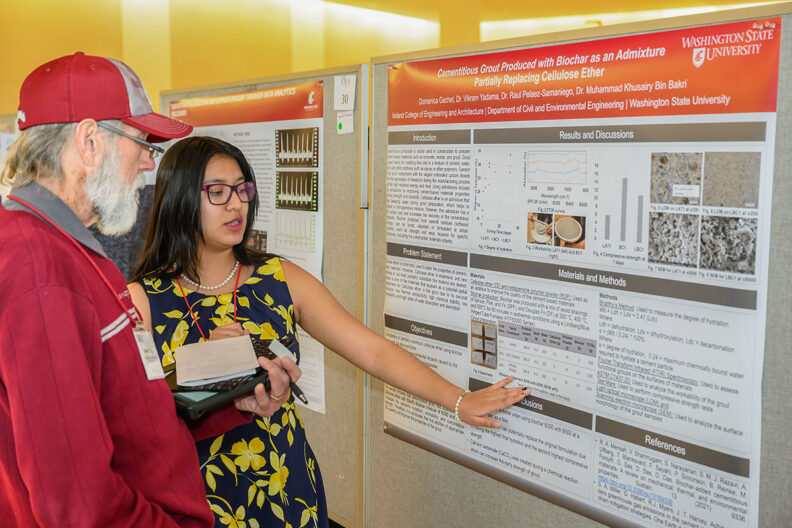
The CUB Senior Ballroom hummed with nerves and excitement as Cougs stood beside research posters they had spent months preparing to explain. Judges leaned in with questions while classmates drifted from project to project. By day’s end, more than 300 undergraduates from every Washington State University campus had shared work that asked bold questions and tested new ideas. For many of them, the Showcase for Undergraduate Research and Creative Activity—known simply as SURCA—was not just a presentation, but a defining moment in how they see themselves as scholars.
Established in 2012 by Mary Wack, former vice provost of undergraduate education, and Mary Sánchez Lanier, assistant vice provost of the division of academic engagement and student achievement, SURCA has grown into one of WSU’s signature undergraduate experiences, even as federal and state funding cuts have made programs like it increasingly difficult to sustain. Its continued growth reflects what is possible when departmental leadership and private donors come together to invest in student curiosity and creativity.
SURCA is unique at Washington State University. It is the only system‑wide forum where undergraduates from every campus and discipline publicly present mentored research or creative work and receive feedback from faculty and subject‑matter experts. The result each year is not just scale, but depth—hundreds of projects that tackle real questions and contribute meaningfully to their fields.
A celebration of ideas
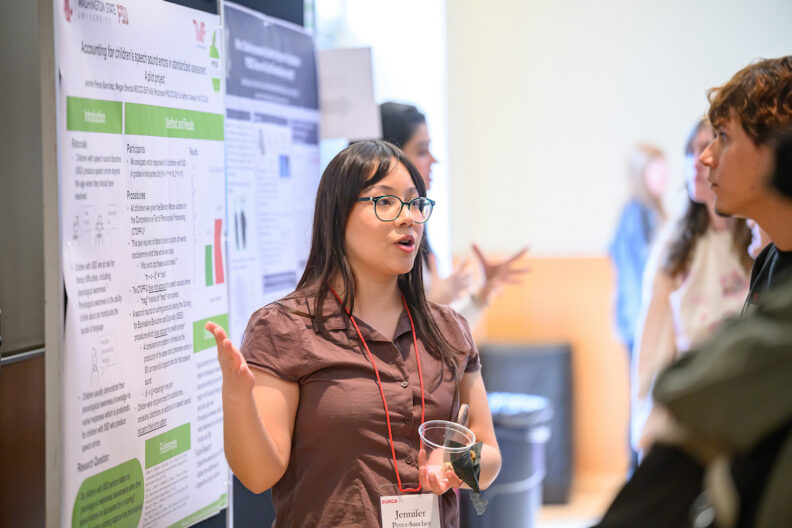
The work presented at the annual event is a testament to the high quality of teaching and undergraduate research taking place at WSU. Each year, undergraduates present their work in one of nine presentation categories. A few titles of this year’s SURCA posters included, “Identifying targets for improving online health navigation skills in older adults” by senior Maya Alger; “Nitrous oxide excitatory input onto hypothalamic pro-opiomelanocortin neurons that decrease body weight” by senior Rashi Karda; and “Automated low-cost bioreactor system for waste-to-energy” by junior Jace Dunn. Every project focused on solving a problem or providing new knowledge to a discipline.
By 2:30, the CUB Ballroom hummed as 300-plus students stood by their posters and presented their work while also fielding questions from judges. After more than 200 judges made their rounds, large numbers of students then entered the ballroom like a fresh wave of energy, moving along the temporary walls of posters to view the work of their classmates and friends.
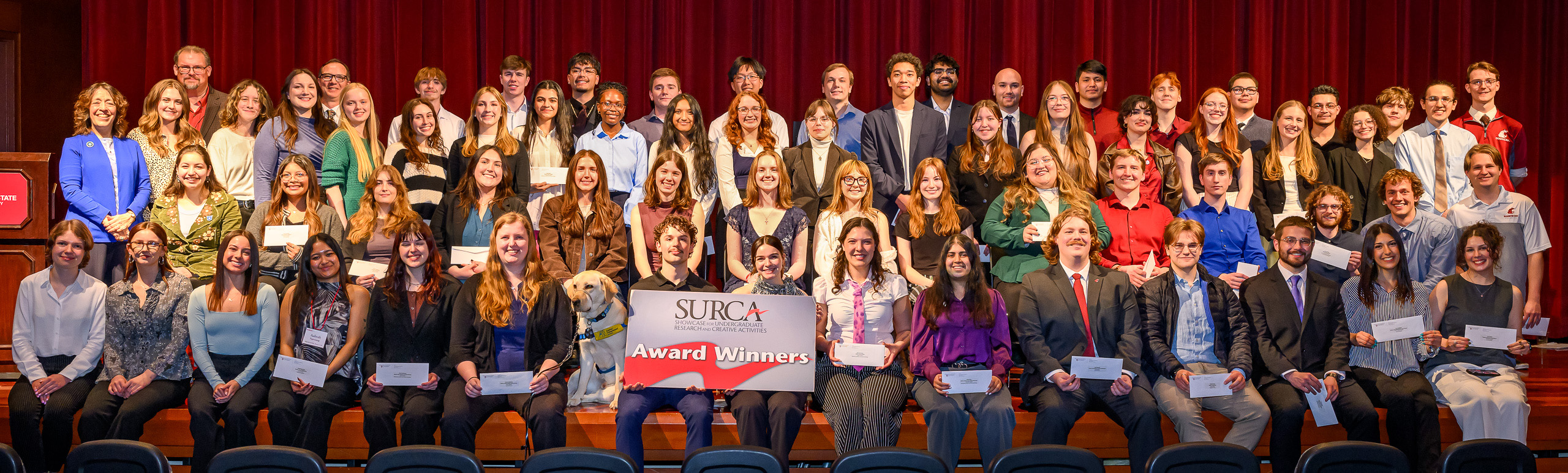
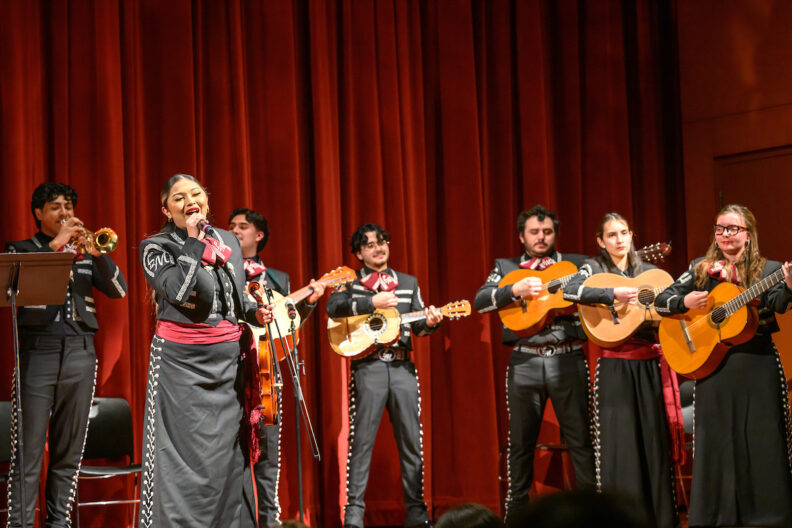
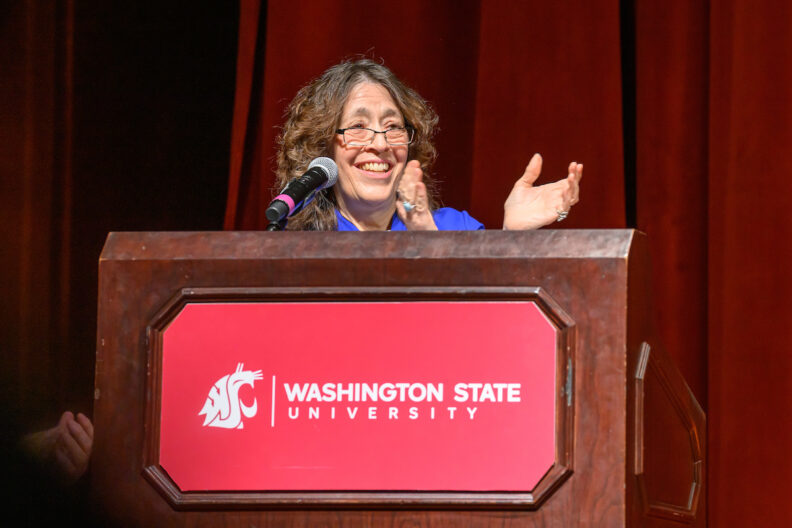
Before 5:00, students, faculty, and staff gathered in the CUB Auditorium for the awards ceremony, while WSU’s own Mariachi Leones Del Monte played mariachi songs—a joyful celebration after all the hard work of students. With the auditorium packed with hundreds of people, anticipation reached a peak just as the awards ceremony kicked off with an introduction by Assistant Vice Provost Sánchez Lanier, who told the audience, “The mentored research and creative activity presented by WSU students never ceases to amaze me—extremely high caliber—and every year I think this is perhaps the most remarkable we’ve seen yet.”
After the award winners were honored, Sánchez Lanier congratulated all the students and encouraged everyone to continue their research, adding, “Because many of you, including those who did not receive awards, will go on to do important work.”
Finding a path through research
Without question, SURCA gets undergraduates excited about science and scholarship by sparking their intellectual curiosity—that inner drive to understand the world around us—a powerful force that often leads students to paths of study they never thought they would explore or pursue. Students who have participated in SURCA will tell you it was one of the most transformative experiences of their undergraduate years because the program shaped their thinking about what they want to pursue in life.
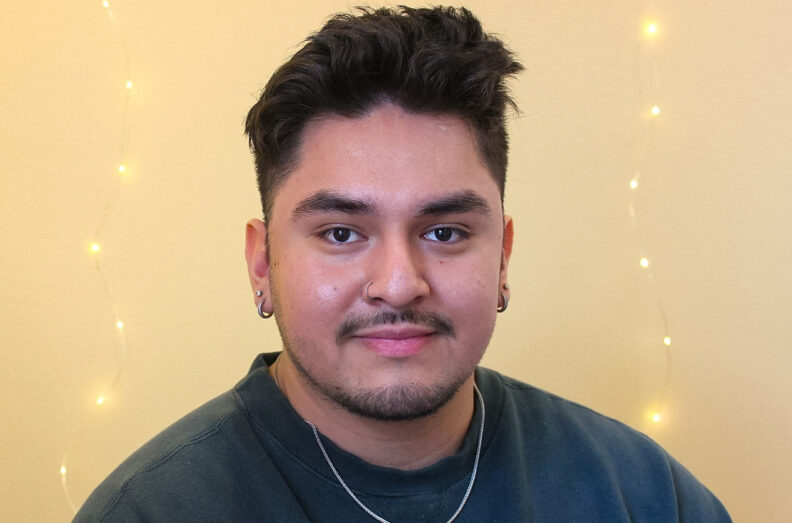
Joan “Jo” Castaneda Gonzalez participated in the 2025 and 2026 SURCA events but never received a SURCA award. A first-generation college student who transferred from Whatcom Community College to WSU Pullman in 2023, Castaneda Gonzalez began his research project the summer of 2023 under Assistant Professor Anjali Sharma’s Translational Nanomedicine Research Laboratory in the WSU College of Arts and Sciences, researching the development of nanocarriers (advanced submicron-sized delivery vehicles used in the transport of therapeutic agents or drugs) for a liver cancer treatment.
“Unlike traditional methods that distribute drugs throughout the body like a bus,” Castaneda Gonzalez said, “our approach works like a taxi, improving precision delivery while minimizing off-target exposure of healthy cells and significantly reducing side effects.”
And though he did not receive a SURCA award, his SURCA experience taught him a key lesson about his development as a scientist: “It’s so important to be able to explain complex scientific concepts in an understandable way,” said Castaneda Gonzalez, “so everyone can understand what’s at stake. If we as scientists can’t clearly explain our work to everyone, then we’re failing, because we all need to understand how science affects our lives.”
SURCA also prepared him to present his work at ABRCMS 2025, an annual national conference for multidisciplinary science and workforce development. He received the biochemistry award. Last spring, he also received a highly competitive Barry Goldwater Scholarship, a coveted national award recognizing outstanding undergraduate STEM achievements. Established by Congress in 1986 to support future STEM leaders, the scholarship provides recipients with $7,500 per year in financial support.
Castaneda Gonzalez also received a WSU scholarship, allowing him to spend last summer conducting organic chemistry research at the University of Minnesota. There, his research impressed his lab leader and others, who encouraged him to apply to the University of Minnesota to pursue a PhD in chemistry. He did and has been granted a full graduate fellowship.
Where philanthropy powers curiosity
Because so many SURCA participants go on to continue their research, the Office of Undergraduate Research seeks to encourage students with more SURCA awards, research fellowships, travel awards, and mentoring opportunities. However, all these awards and related opportunities are made possible through the generous support of donors.
One such SURCA donor, Robert “Bob” Rieck ’77 (Honors), has been a major supporter of SURCA for many years. After receiving his chemical engineering degree, he worked at Hanford as a processing engineer, where he refined a glassification (vitrification) process that immobilizes high-level radioactive waste by turning it into a stable, solid glass form.
Turning a passion for science into opportunities for Cougs
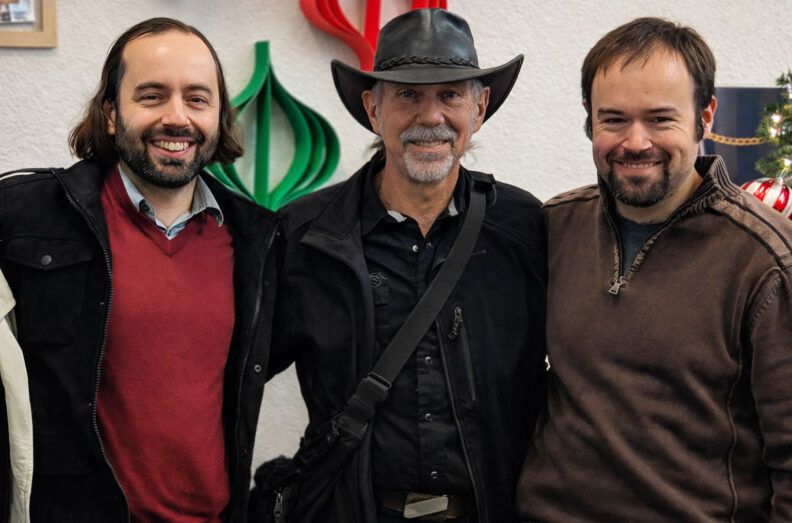
An ardent supporter of providing opportunities that engage students in science, research, and problem-solving, Rieck volunteered for decades as the chairman of the Mid-Columbia Regional Science Fair Association to advance youth engagement in science. Rieck is also a devoted Coug, along with his two sons, who are also passionate about science. He and his sons, Daniel and Bennett, all earned their Bachelor of Science degrees in chemical engineering from WSU. Daniel and Bennett both earned WSU master’s degrees in chemical engineering, and Daniel went on to earn his PhD in chemical engineering at WSU. Daniel also is the web developer for the WSU Office of Undergraduate Research, and so when Daniel told his father about the SURCA program, Bob not only got involved, he became a major donor.
Bob has always been passionate about making learning opportunities available to students that engage them in the scientific method—careful observation, hypothesis testing, and experimental validation. As Bob said, “My best classes were the ones where I learned how to learn, how to question things and solve problems. Engaging students in the scientific method is one way to do that.”
In addition to his philanthropic passion and his commitment to helping the Office of Undergraduate Research grow its SURCA program, he is also excited to be involved as a judge.
In fact, Both Bob and Daniel have served as SURCA judges for nearly a decade—Bob coming into Pullman every year to judge. He and Daniel shared their judging insights.
“What I’m looking for in student presentations,” said Bob, “are a clearly formulated hypothesis, the experiments developed to test their hypothesis, and their analysis of the data and their conclusions.”
Daniel’s criteria are slightly different: “I’m looking to see if they’re truly engaging in the scientific method and thinking about their project critically. And I’m also looking for their passion about their work.”
Bob and his wife, Mary, had been generous to WSU in the past, supporting scholarships and other programs, but after Mary passed, he increased his involvement in and giving to SURCA.
“One can see the impact SURCA has on the intellectual development of students. That’s why giving to this program was a no-brainer,” said Bob. “What these kids get from SURCA is powerful—solving problems, which is at the core of everything we do in life. That’s why I want to see this program grow.”
Mary Sánchez Lanier is very grateful to Bob Rieck and other donors who are helping WSU expand the SURCA program. “Because it really is powerful. These students,” said Sánchez Lanier, “will go on not just to make discoveries about science and scholarship, but they will also make important discoveries about themselves and what they’re capable of.”
If you would like to give to the WSU SURCA program, contact Tara Howe, senior director of central scholarships, at 509-335-1240 or at tkhowe@wsu.edu.
You can also give to SURCA at the WSU Foundation online giving site.