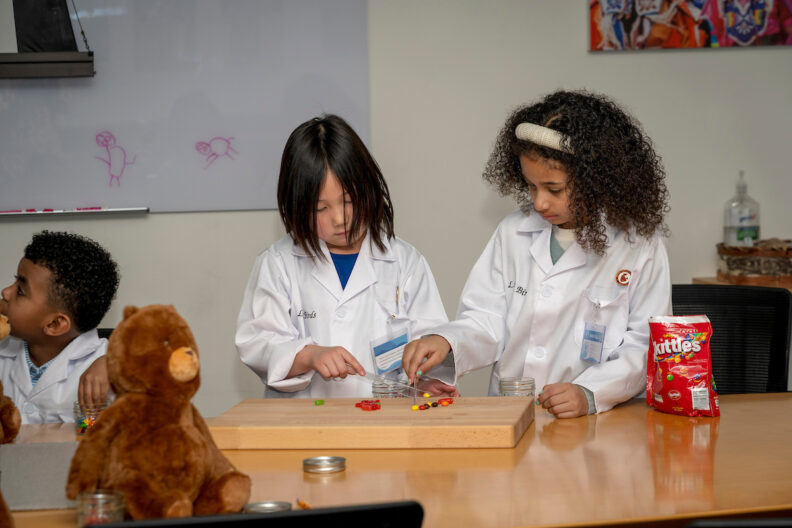
On a cold morning last spring, a young boy from a local tribal community near Spokane walked into his classroom wearing a white doctor’s coat nearly three sizes too big. He earned the coat during the pilot of Washington State University’s new Little Birds program—part of the Na-ha‑shnee Youth Pathway Programs in WSU’s Native American Health Sciences (NAHS).
He stood proudly beside his science teacher and announced, “I’m a scientist too.”
That moment, shared later with the NAHS team, captured everything Little Birds is designed to do: help Native youth see themselves in the health sciences as children, long before doubt has a chance to take root.
Planting the Seeds Early
Little Birds grew out of conversations with WSU’s Tribal Advisory Board. For years, NAHS has supported middle and high school students through a variety of programs, but by high school, many students have already decided science “isn’t for them.” Research backs this—children’s beliefs about their abilities and place in the world form early, often before age 12. Tribal leaders throughout the region had a clear message for the NAHS team: start earlier.
Jerry Crowshoe (Piikani Nation), director of programs and student services for NAHS, recognized the urgency. As a mental health psychologist, he knows that early experiences can shape a lifetime.
“Zero to 12 years old is a pivotal stage, where, in essence, a child’s mind gets hardwired in those 12 years for how they’re going see the world,” he explained. “And then, once the mind gets hardwired, they move into their identity phase. Who am I in this world that I painted and what’s possible for me?”
K-12 Coordinator Hannah Tomeo (Colville, Yakama, Nimiipuu, Sioux) had already been considering what age-appropriate health science exposure could look like. A teddy bear clinic model—used in large hospitals—served as inspiration. But she imagined something more immersive, culturally grounded, and accessible directly within tribal communities.
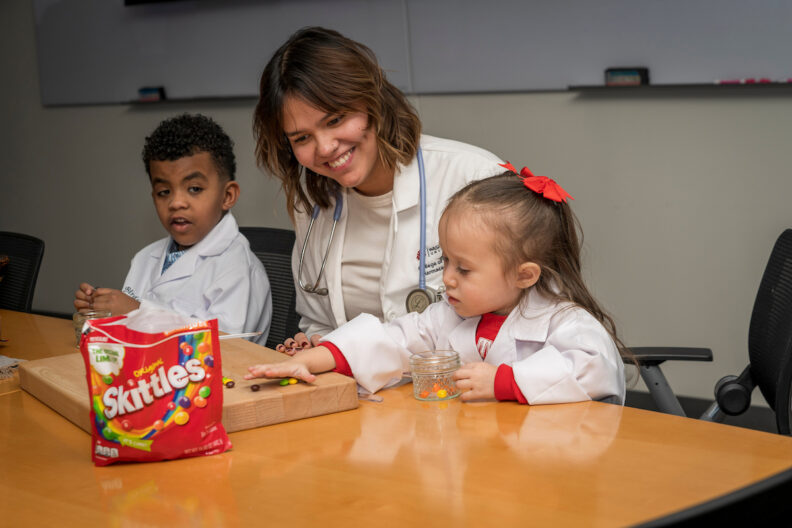
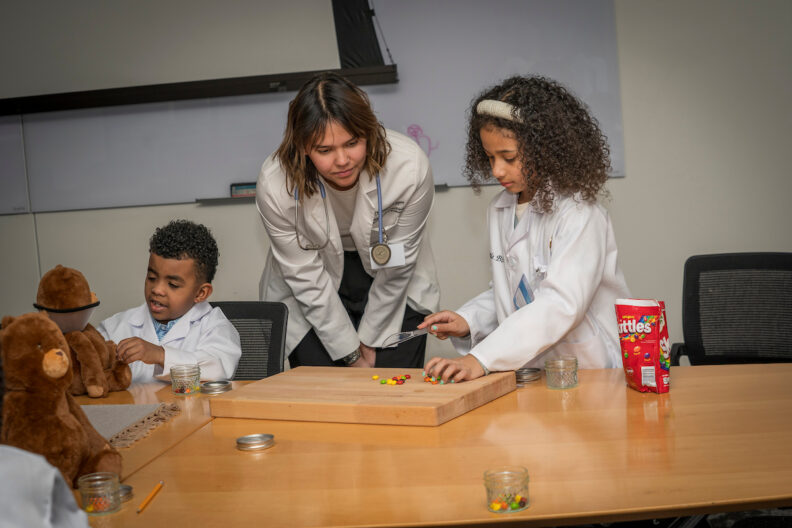
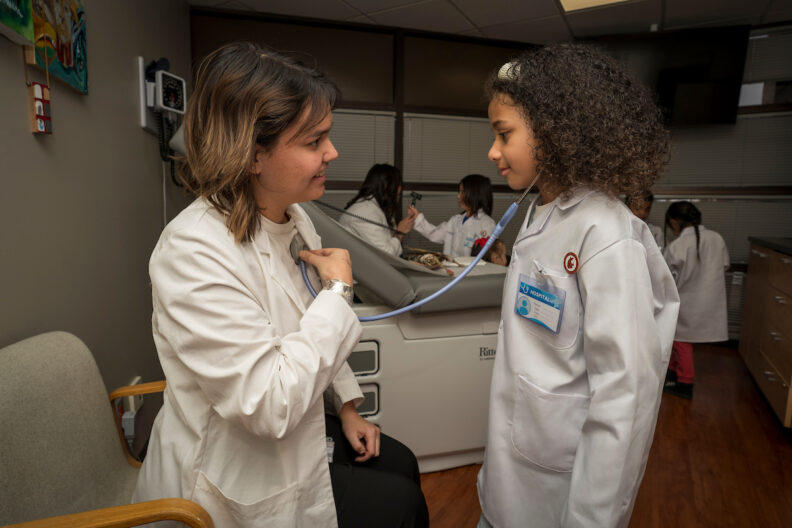
Together, Tomeo and Crowshoe envisioned a six-month, play-based pathway program led by current WSU health sciences students that could travel to reservation schools and Spokane-area classrooms. Participants would explore pharmacy, medicine, nursing, nutrition, and speech and hearing sciences through fun, hands-on activities.
“Kids learn best through play,” Tomeo said. “We realized that if we could bring the colleges to them, dress them up like doctors, and let them feel that identity, the experience could spark a love for science and that desire for the healthcare field at a really young age.”
White Coats, Big Dreams
Denise Andreotti-Phillips (Diné), now enrolled in the WSU Elson S. Floyd College of Medicine’s Nmryaqs program, a post-baccalaureate pathway for tribal members, knows firsthand just how transformative those early childhood experiences can be.
At age five, Andreotti-Phillips was visiting an Indian Health Service (IHS) hospital on the Navajo reservation, where her mother worked, when a physician draped his own white coat over her shoulders. More than two decades later, she still remembers the weight of it, the University of Florida patch on the chest, and the way two other doctors greeted her in the hallway: “Hello, Dr. Phillips.”
“I felt like their colleague,” she recalled. “That white coat became a reminder of what I wanted to be.”
When Tomeo and Crowshoe described Little Birds—complete with WSU white coats and a graduation ceremony—she instantly understood its power.
“When that white coat was put on me, I really felt like a doctor, because as a kid, that white coat was synonymous with doctor. It symbolizes the whole professional identity of a doctor, you know, the trust, the expertise, the responsibility, and the sacredness of caring for others,” Andreotti-Phillips said.
Her story echoes the outcomes Little Birds hopes to cultivate in tomorrow’s healthcare leaders: confidence, representation, and the belief that Native youth belong in health science careers.
Building Trust, Building the Future
Little Birds is more than an introduction to science. It is also a step toward healing, trust-building, and reconciliation between tribal communities and the healthcare system.
Generations of Native families carry memories of mistreatment, from historical trauma to modern-day disparities in access and cultural understanding. Stories are passed down through tribal communities, including the painful legacy of boarding schools, neglect, and cultural disrespect in healthcare settings. These experiences contribute to ongoing distrust and a shortage of providers in tribal communities.
“There’s a misconception that all tribes have casinos, you know, that they can pay for good doctors and nurses, and it doesn’t work that way,” Crowshoe said. “We have 29 tribes in Washington state, and many of them are rural. Many of them still, to this day, are struggling with the quality of care.”
Little Birds offers a hopeful path. As children build positive experiences with health science students and faculty who show up month after month, trust grows. And as WSU’s health science students volunteer in tribal settings, they are also gaining experience that will shape how they practice in the future.
“It’s a reciprocal relationship,” Crowshoe said. “The kids gain confidence, and our students learn how to care for communities with respect.”
Maintaining Momentum, Helping Little Birds Soar
Though still young, Little Birds has captured widespread interest. Schools across eastern Washington—and even farther across the state—have already reached out, asking to participate.
The challenge is capacity. The program is free for schools, and NAHS operates with a small staff and limited funding.
Recent philanthropic support is helping Little Birds spread its wings. The program recently received a $5,000 grant from the Puyallup Tribe of Indians Charity Trust Board and a $2,500 grant from the Squaxin Island Tribe, which will provide essential resources, including children’s lab coats, teddy bears, learning materials, and stipends for WSU student volunteers. Still, demand exceeds available resources.
“We need support to keep this work going,” Tomeo emphasized. “There’s so much excitement, and we want to meet it.”
Philanthropy will play a vital role in sustaining Little Birds and expanding it into more schools and tribal communities. Most importantly, donor involvement will give children the opportunity to imagine themselves in roles Washington communities desperately need.
Because sometimes, one moment—one white coat—is all it takes to change the trajectory of a life.
If you would like to make a gift to the Little Birds program, please contact Zach Patterson at zach.patterson@wsu.edu or visit the WSU online giving page.