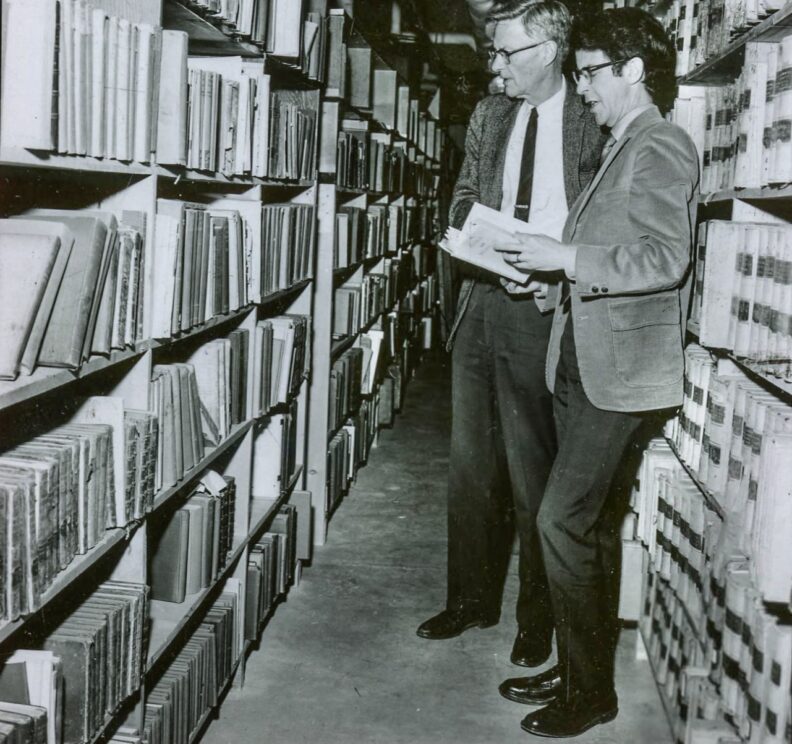
This year marks the 55th anniversary of Washington State University Libraries’ acquisition of the Leonard and Virginia Woolf personal library—a collection that never would have found a home at WSU’s Manuscripts, Archives, and Special Collections (MASC) were it not for the former chairman of the WSU English Department, John Elwood. In 1967, Elwood was on sabbatical in England with his wife Karen and their three sons when they visited the Bow Windows Bookshop in Lewes, East Sussex, a few kilometers north of Monk’s House, Virginia and Leonard Woolf’s country residence.
Fred Lucas, the bookshop’s owner, showed them a few first editions of the Hogarth Press, founded by Virginia and Leonard Woolf. Elwood was in literary heaven, especially when Lucas later introduced him to Leonard Woolf, who showed Elwood a first edition of T.S. Eliot’s The Waste Land. During their time in England, the Elwoods developed a friendship with Lucas and his wife Nancy that continued through correspondence after the Elwoods’ return to WSU.
About a year after Leonard Woolf’s death in 1969, Nancy Lucas wrote to the Elwoods, letting them know that Fred was looking for a buyer for the Woolf Library books. Elwood knew other buyers were waiting in the wings, likely Harvard, Yale, and, as it turned out, the University of Texas, so he immediately spoke with G. Donald Smith, then director of WSU Libraries, who authorized Elwood to proceed with purchasing the books.
The purchase was complicated by an auction of 400 highly collectible books that had been pulled from the library by Woolf’s executor. WSU bid on many of those and acquired 30 of the titles.
“It was an extraordinary feat that Elwood pulled off the purchase, not to mention a labor of love for WSU,” said WSU Libraries Dean Trevor Bond.
Through his diligence and his relationship with Lucas, Elwood managed to procure the vast majority of the library ahead of other buyers. When the collection arrived at WSU in 1971, the 4,000-plus titles included books Leonard had purchased throughout his life beginning as a Cambridge student, along with all the books given to him to review during his career as a literary critic; books Virginia collected and inherited from her parents, mostly from her Cambridge educated father, Sir Leslie Stephen, who was part of a close-knit group of Victorian writers, academics, and reformers often referred to as England’s intellectual aristocracy; and volumes from Virginia and Leonard’s Hogarth Press.
A collection that keeps growing thanks to WSU donors
In 1974, MASC purchased a collection of Hogarth Press publications from Trekkie Parsons who had inherited them, along with Monk’s House, from Leonard—the two became lovers after Virginia’s death. In 1979, MASC purchased 400-plus volumes from Leonard’s nephew, Cecil Woolf, who had been gifted many of the books from his uncle over many years. And in 1983, MASC purchased 100 books from Quentin Bell, Virginia’s nephew and biographer. And because the Hogarth Press holdings were incomplete, MASC continued to acquire those titles.
In the past 25 years, acquisitions have been possible thanks to the John W. and Mildred Sherrod Bissinger MASC Excellence Endowment, established by Mrs. Bissinger, an alumna and poet who admired Virginia Woolf’s works and those of the Bloomsbury Group—a circle of influential 20th-century writers and artists published by the Hogarth Press that included Virginia and Leonard Woolf. In addition, Diane Gillespie, WSU professor emerita of English, has given MASC a generous gift to support the Woolf Library. Because of their gifts, MASC has grown the collection through various rare book collectors and auctions, acquiring first editions of all 527 titles of the Hogarth Press (published between 1917 and 1946) and other volumes associated with Virginia Woolf and the Bloomsbury Group. As a result, this historic collection is now approximately 9,900 volumes.
The Hogarth Press
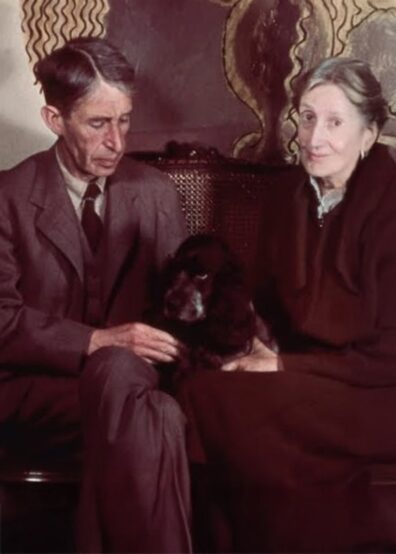
In 1917, Virginia and Leonard Woolf founded Hogarth Press with a handpress set up in the dining room of their townhouse, called Hogarth House, in the London Borough of Richmond. Their first publication, Two Stories—150 copies—included one story by Leonard and a second by Virginia. They soon added another press and moved to the basement.
In the 1920s, Virginia was writing her most important works—Jacob’s Room (1922), Mrs. Dalloway (1925), To the Lighthouse (1927), Orlando (1928), A Room of One’s Own (1929)—all published by Hogarth Press, which in 1922 expanded to commercial printing, publishing bestsellers with runs of tens of thousands of copies.
Also, in 1922, Virginia’s novel Jacob’s Room was among Hogarth’s initial hardcover publications featuring a pictorial dust jacket designed by Virginia’s sister, Vanessa Bell, a celebrated modernist English painter and member of the Bloomsbury Group. Bell went on to design all the dust jackets for Virginia’s works.
The MASC Woolf Library
Upon browsing the titles of the Woolf personal library, one immediately sees a serious library—Bacon, Hume, Darwin, Plato, Coleridge, Milton, Tocqueville, Shakespeare, Thucydides, and others. Likewise, the Hogarth Press titles range from T.S. Eliot’s The Waste Land to the works of E. M. Forster, Katherine Mansfield, Christopher Isherwood, Rainer Maria Rilke to the seminal works of Sigmund Freud and Carl Jung to the first English translations of Russian writers Maksim Gorky and Fyodor Dostoevsky, along with many modern writers.
According to Diane Gillespie, who has studied the collection since 1975, “Biographical works—letters, diaries, and memoirs—form the largest group of the Woolf personal library.” And while the Hogarth Press collection tends to focus on literary works, Gillespie has come across many curious titles, including two murder mysteries by C.H.B. Kitchin, a novel satirizing wedding rituals, a book on investing, a collection of last words, and an etiquette guide, to name a few. There are also works concerned with the dark future of a looming war—a 1939 volume about the German Army and a 1940 book focused on the control of “aliens” (refugee unnaturalized citizens) in the British Commonwealth.
“Some of the books have Virginia Woolf’s inscription inside,” Bond said, as he pulled one from the shelf, the first of two volumes titled The Fable of Bees—inside the jacket: an inscription written by Virginia Woolf in a wispy, ethereal script, dated 1938. “That tells us she read this in 1938.”
During such a moment, one feels drawn into her world of ideas, but also feels a chill, knowing she took her life three years later.
Virginia Woolf would likely not have been the writer she was without her unique upbringing in an intellectual family. Her tutoring in Ancient Greek, Latin, French, and the literary and historical canons, combined with her love of reading that began as a girl, shaped a brilliant mind in conversation with the many ideas she encountered. The Woolfs’ personal library provides a glimpse into that conversation, and while the collection is an invaluable resource for researchers, it is also accessible to the public.
To commemorate the collection and Virginia Woolf writings, Dean Bond commissioned Assistant Professor of Art, Jiemei “Mei” Lin, to create a mural of Virginia Woolf and her sister Vanessa Bell. In a month’s time, Lin painted the striking mural of the two sisters that includes imagery of the dust covers Bell designed for Virginia’s books.
WSU Libraries will celebrate the new mural at 4 p.m., Wednesday, Sept. 24, in the Terrell Library Atrium. The public is invited. To contribute to the WSU Libraries or MASC, visit Friends of the Libraries – The Libraries or contact Shane Johnson at sj.johnson@wsu.edu or at 509-335-1079.