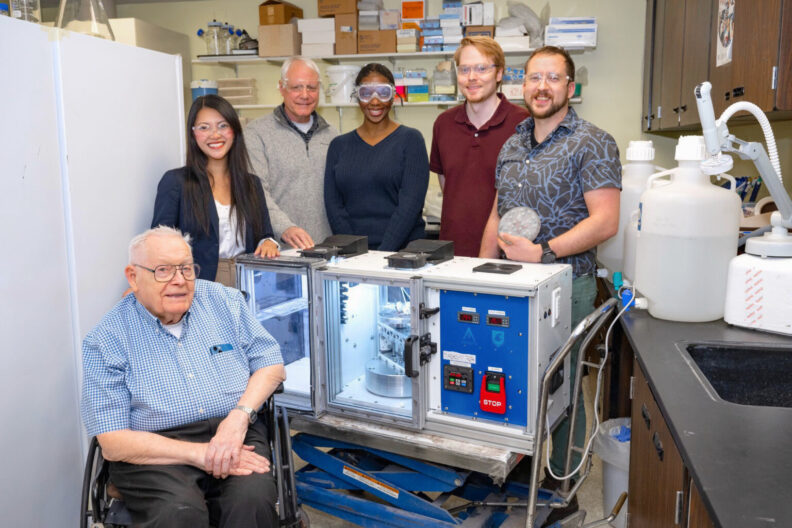
Dr. William C. Davis, a pioneer in veterinary immunology who transformed the field with his groundbreaking work on monoclonal antibodies, continues to inspire future scientists through philanthropy and mentorship.
Few scientists can claim to have literally written the book on their field, but Dr. William “Bill” C. Davis, director of the Washington State University Monoclonal Antibody Center, has done just that—transforming veterinary immunology along the way.
When he first arrived at Washington State University in 1968, knowledge of the immune system was still in its infancy. The link between zoonotic disease and public health was not fully appreciated or understood. Now, more than five decades later, Davis’ groundbreaking work using monoclonal antibodies to characterize the immune systems in livestock and companion animals has revolutionized approaches for vaccine development and earned him recognition as a global pioneer.
This same passion for harnessing scientific innovation to improve lives and industry has also led Davis to personally invest in the next generation of scientific inquiry at WSU through both philanthropy and service.
From the Bay Area to the Palouse
Davis’ journey to WSU began with a chance encounter. While earning his PhD in medical microbiology from Stanford University School of Medicine, he met John Gorham and Jim B. Henson, two veterinary professors from WSU, visiting as part of a seminar tour. The pair was promoting the use of animal models in the study of autoimmune diseases. Later, during a postdoctoral fellowship in immunology and hematology at the University of California San Francisco Medical Center, Davis crossed paths with Gorham and Henson again during another promotional tour. Gorham and Henson were eager to expand WSU’s immunology research into veterinary species and thought Davis would be a valuable addition to their research team.
“There was an empty laboratory, an electron microscope, and not much else,” Davis recalls of the WSU pitch—a stark contrast to his experience at Stanford and UCSF. But what WSU lacked in resources, it made up for in the opportunity to conduct groundbreaking research.
Davis soon packed his bags and moved to Pullman with his wife and young family, where he accepted a position in the College of Veterinary Medicine.
Revolutionizing veterinary immunology
During his early years on campus, Davis provided meaningful insights into how lentiviruses cause disease in animals, such as horses and minks. However, his most enduring contributions came in 1979, after another team of investigators developed a method to capture and immortalize B cells, producing a single (monoclonal) antibody of known specificity in laboratory mice. This breakthrough revolutionized the development of antibodies needed to characterize the immune system and immune responses in humans and other species. Davis and his team successfully built on this work to adapt emerging monoclonal antibody technology for use in veterinary science. His development of monoclonal antibody reagents laid the foundation for understanding animal immune responses and vaccine development.
In 1982, Davis established the WSU Monoclonal Antibody Center, a hub for producing and distributing monoclonal antibodies to researchers worldwide. Over the decades, and in partnership with teams at institutions around the globe, Davis and the center have advanced life-saving immunological research and vaccine development for both livestock and companion animals.
A legacy of service and philanthropy
Throughout his career, Davis has remained deeply involved in growing and strengthening WSU’s College of Veterinary Medicine. He played a pivotal role in recruiting Dean Leo K. Bustad, whose leadership advanced the college’s reputation. He was also heavily involved in designing and construction of Bustad Hall.
“Bill’s leadership in the field has been nothing short of transformative,” says Kelly Brayton, chair of the Department of Veterinary Microbiology and Pathology at WSU. “His decades of dedication to WSU, his pioneering research, and his continued generosity have all left an indelible mark in our department, the College of Veterinary Medicine, and the wider scientific community.”
Adding to that legacy, in 1998, Davis and his wife, Elizabeth (“Betty”) Davis, who passed away in 2019, established the Bill and Betty Davis Endowment for Basic and Applied Research in Immunology of Food and Companion Animals—a fund that supports research aimed at understanding immune responses and developing improved animal vaccines.
“WSU has given me a chance to achieve by providing me the environment and freedom to have a research career,” Davis explains, remembering a comment from his mentor Sydney Rafael, a pioneer in tuberculosis research and former dean of the Stanford University School of Medicine, “It’s not where one obtains their professional degrees it is what is done with them at the institution where they pursue their career.”
Today, Davis remains focused on developing vaccines for pathogens that cause disease in humans and animals, including tuberculosis, Crohn’s disease, and brucellosis. While challenges remain, particularly in understanding the immune response to pathogens, navigating regulatory hurdles, and battling online vaccine misinformation, Davis remains optimistic.
“People should remain innovators,” he says. “Research requires a whole-hearted effort to achieve something—to be a successful investigator.”
For information on how you can support WSU’s College of Veterinary Medicine and the Bill and Betty Davis Endowment for Basic and Applied Research in Immunology of Food and Companion Animals, contact Lynne Haley at lynne_haley@wsu.edu or visit the College of Veterinary Medicine’s giving page.