Here’s a snapshot of several major gifts—from $25,000 to $3 million—that encompass a wide range of giving opportunities: from medicine to honey bees to Skagit County Extension.
When alumnus Alexander Swantz passed away last June at the age of 101, a pledged gift from the Swantz family created the Alexander and Elizabeth Swantz Distinguished Professorship in the College of Agricultural, Human, and Natural Resource Sciences. Read the WSU Insider story.
Alumna Nancy Kercheval made a gift of $150,000 to honor her mother, Ruth Wylie, that will help fund the Ruth Wylie Head House—a research hub at WSU’s Northwestern Washington Research and Extension Center at Mount Vernon. Wylie, also an alumna, was Skagit County’s first woman commissioner and county treasurer. Read the WSU Insider story.
With the aim of helping curb food insecurity among students, Lamb Weston made a third donation of $25,000 to Cougar Cupboard, the WSU Tri-Cities food pantry. Read the WSU Insider story.
President Kirk Schulz and First Lady Noel Schulz, along with Chancellor Sandra Haynes, were the first to donate for naming rights for the new state-of-the-art academic building set to open this fall at WSU Tri-Cities. Read the WSU Insider story.
A $500,000 gift from an anonymous couple was the latest in a series of significant contributions made to support the Elson S. Floyd College of Medicine’s first family medicine residency program in Pullman. Read the WSU Insider story.
This anonymous gift builds on a $250,000 gift from alumni Tom and Linda Nihoul, also in support of the medical residency program in Pullman. Read the WSU Insider story.
Northwest Farm Credit Services donated $2 million to multiple programs, including honey bee research, tree fruit research, viticulture and enology, dairy science, 4-H, irrigated and dryland farm research, and the WSU chapter of the student organization Minorities in Agriculture, Natural Resources, and Related Sciences (MANRRS). Read the WSU Insider story.
A $3 million gift from the Rosalie & Harold Rea Brown Foundation will establish an endowed chair in plant pathology, with the aim of reducing losses caused by plant diseases and thereby improving food security. Read the WSU Insider story.
The Paul Lauzier Charitable Foundation made a gift of more than $1.5 million to support the new Life Sciences Teaching Laboratory, under development at the Ste. Michelle Wine Estates WSU Wine Science Center on the Tri-Cities campus. Read the WSU Insider story.
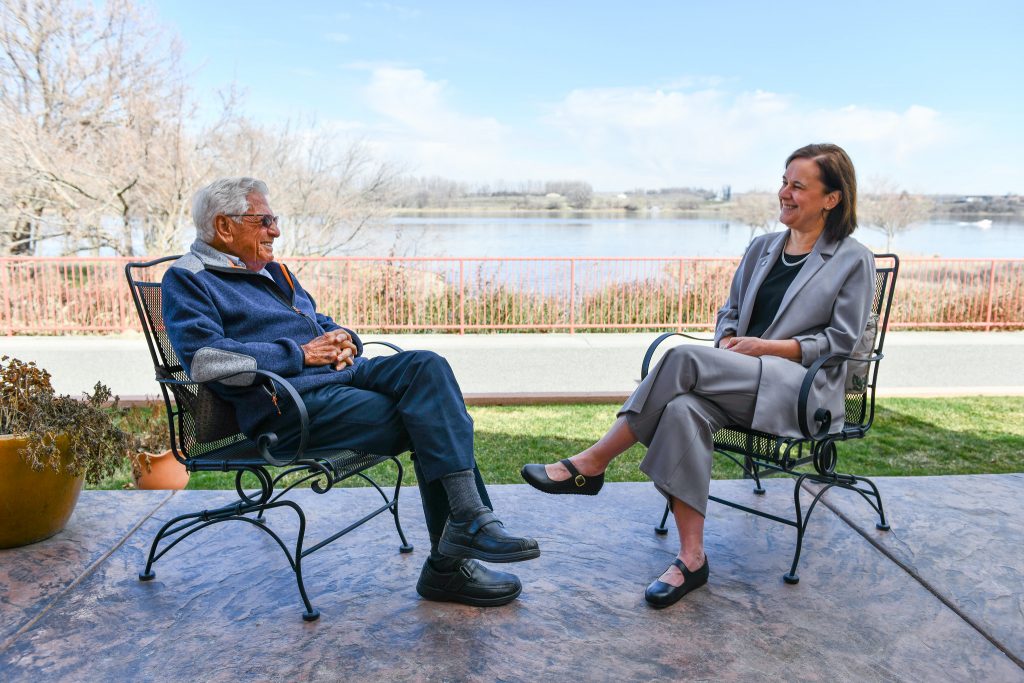
Bob Ferguson (left) chats with WSU Tri-Cities Chancellor Sandra Haynes.
When the Chancellor of WSU Tri-Cities gave a talk at Rotary, little did she know that a brief mention of WSU’s renowned ice cream shoppe would open the door to a $500,000 gift
In early 2018, shortly after Sandra Haynes took the helm as chancellor of WSU’s Tri-Cities campus, she was invited to speak at the Richland Rotary Club of Tri-Cities. As part of her presentation, she casually mentioned how much she would love to bring Ferdinand’s to the Tri-Cities in some way, shape, or form.
In the audience was retired nuclear physicist and longtime Tri-Citian Bob Ferguson, who wholeheartedly agreed. When the two of them were introduced, Ferguson led with Ferdinand’s.
“In typical Bob fashion,” Haynes recalls, “he offered a list of creative ideas” for how a local Ferdinand’s could be realized.
Their shared enthusiasm for WSU’s famous creamery has not resulted in a local storefront (yet!). But it proved to be a congenial conversation-starter that eventually led to an exploration of Ferguson’s other passions.
Chief among them is his vision for transforming the Tri-Cities area into a clean-energy, post-carbon research innovation and economic hub.
This investment lays the groundwork for a world-class research institute that promises to transform not only the Tri-Cities region, but also the world’s collective energy future, as we look beyond fossil fuels to the development of sustainable energy sources.
“Affinity” and the Crosby Family Connection
Bob Ferguson is part of the extended Bing Crosby family, by marriage.
After making that initial Ferdinand’s connection, Haynes began to explore other ways of getting to know Ferguson’s many interests. She knew he had already endowed a scholarship at WSU Tri-Cities, named in memory of a fellow scientist, and wanted to find a way to build on this commitment.
She kept in touch with Bob regularly and attended his book-signing when he released a book he had written on the Hanford Site, where he had worked for many years. And she learned that he sponsored an Irish musical group, Affinity, to travel the Tri-Cities every year for a concert.
Affinity features an Irish harpist, pianist, and vocalist—with guest appearances by Howard Crosby, nephew of the legendary crooner, Bing Crosby, who grew up in Spokane. Howard Crosby is also the brother of the late Katie Crosby (Bing Crosby’s niece), who was Bob Ferguson’s wife for 62 years before her passing in 2018. In other words, Ferguson is part of extended Crosby family by marriage.
Ferguson asked Chancellor Haynes if WSU Tri-Cities might be able to host the Affinity concert in 2018; she was able to secure a performance space and the proceeds from the concert went to benefit WSU Tri-Cities. They immediately began planning the same arrangement for the following year.
This collaboration led to conversations about funding another scholarship, this time dedicated to supporting entrepreneurship, and Ferguson made that gift in 2019.
But Ferguson’s relationship with WSU accelerated to an entirely different level when he was introduced to Jaime Heppler, who joined WSU in mid-2019 as senior director of development for Tri-Cities.
And here’s where the Crosby connection comes into play in an entirely different way: Howard Crosby—Bob Ferguson’s brother-in-law—is a longtime family friend of the Heppler family (also from Spokane), and would sing Bing Crosby songs to Heppler when she was a child—and now sings to her children.
Whether it was the personal connection between their families, or perhaps the timing was just right, given all of the relationship-building that had come before, the early conversations between Heppler and Ferguson went straight to the core of the impact he most wants to make—on the Tri-Cities campus, on the region, and on the world’s energy future.
The “Bob Wall”
Ferguson’s storied career in nuclear energy began in 1957 at Hanford, where he was a physicist and operations supervisor at the B Reactor—the world’s first large-scale nuclear reactor, located in the Tri Cities. In 1978, he was appointed deputy assistant secretary of nuclear programs for the U.S. Department of Energy in Washington D.C., then in 1980 made his way back to the Tri Cities to serve as CEO for the Washington Public Power Supply System—now called Energy Northwest.
Ferguson’s deep history in the energy industry and extensive understanding of the unique confluence of energy resources in the Tri-Cities region—hydropower, wind, nuclear, and solar—has led him to envision an ambitious plan for further developing all of these resources in tandem, as a single integrated energy system.
During one of their first meetings, he sketched all of this out in elaborate detail on the whiteboard in Heppler’s office. This is now affectionately called “The Bob Wall.”
“Once he finished, I said ‘I’m never erasing this board,’” said Heppler. She immediately brought in Haynes to show her. “This is the vision.”
In fact, Ferguson’s vision aligned exactly with the direction WSU Tri-Cities had already determined it was heading.
“When setting the direction for this campus, we were inclusive of our stakeholders and listened to our community to determine their interests. We affirmed that the region is rich in energy research, production, innovation, and entrepreneurship,” says Haynes. “The Columbia and other rivers provide hydropower. Over 300 days of sun per year for solar energy, lots of wind, the only nuclear reactor in the Pacific Northwest, and a partnership with an on-campus laboratory with Pacific Northwest National Laboratory, where we conduct our biofuels research, rounds out the picture of the importance of energy in the region.”
The next step was to bring in Michael Wolcott, Regents Professor and Associate Vice President for Research at Washington State University.
Wolcott intently studied the “Bob Wall” and said to Heppler, “Gosh, you’ve really got something here.”
Ferguson and Wolcott were soon connected, scientist to scientist, to begin to clarify how Ferguson’s big ideas could begin to be operationalized. Wolcott’s involvement was also important as discussions of a transformative gift began to emerge.
True Credibility
“What Mike brought to the table was true credibility,” says Haynes. “Bringing donors together with those who have the technical expertise is an important part of fundraising. It helps to build confidence and momentum around an idea.”
Over the following months, as those discussions evolved, a proposal was developed—which included a three-page list of scientists throughout the WSU system whose work in energy research will be germane to the Tri-Cities initiative. This underscored the fact that, while Tri-Cities will be the geographic hub for the research institute, this will truly be a systemwide effort that taps expertise from WSU units all across the state.
The original proposal was presented in March 2020 and, after several revisions and modifications, Ferguson made his $500,000 gift in December of that year.
This is the latest chapter in Ferguson’s decades-long history with the campus. He was actively involved in early discussions regarding the expansion of the Tri Cities campus into a fully-fledged WSU campus in 1989.
“This gift is a culmination of the vision we had when we established WSU Tri Cities here,” he says.
Ferguson is now actively working his network of scientists and industry leaders, cultivating them as potential donors to build on his endowed gift. The goal is to reach $2 million, which will be the minimum required to launch the regional institute. He has hosted receptions on his balcony overlooking the Columbia River to talk up the possibilities of this investment, and will soon be hosting a river cruise for a prospective investor.
The conversation has come full circle with Rotary as well. Rotary wants to play a part in WSU Tri-Cities’ energy leadership, and is planning to plant carbon-capture trees on the Tri-Cities campus.
“Energy is the source of all economic development,” says Ferguson. “We need a curriculum. We need a workforce for the future. WSU Tri-Cities is uniquely positioned to integrate all these areas. WSU could lead this effort for the state and the nation.”
Key takeaways from the Ferguson gift story:
You never know when a public talk or casual interaction might lead to something big. Make yourself visible, talk up your passion for WSU, see what happens.
Be patient: Gradual steps may be the path to discovering great possibilities.
Keep the connection active—small gestures can go a long way toward building a strong relationship.
Get personal: Find out where meaningful person-to-person connections can be made.
Bring in the right people at the right time, to establish credibility and confidence that the donor’s investment will be well-stewarded and lead to the intended impact.
Think regional: In considering opportunities to build on this gift, who do you know who has a vested interest in the future of Tri-Cities?
Think thematically: Who do you know who will resonate with the state, regional, and global impact of sustainable energy?
Think reputationally: Who would want to support a marquee program that will distinguish WSU among its peers and beyond?
You can help us build the $2 million endowment to make Bob Ferguson’s vision a reality. Contact Jaime Heppler,jaime.heppler@wsu.edu
Q&A with Lisa King, chair of the WSUF Board of Directors, who shares her unique path to earning her degree and her perspective on maximizing impact as a volunteer.
Lisa King (’08) is completing her first year as chair of the Board. She met her husband, Jim King (’80), as an undergraduate at WSU, and together they have earned a well-deserved reputation as inspiring leadership donors, volunteers, fervent Cougar fans, and WSUAA Platinum Lifetime Members. Their daughter, Emily, has followed in their footsteps, earning her WSU degree in 2011, and now works in WSU’s Seattle development office for Athletics.
Q: You had an unusual path to earning your degree—by starting your studies in the late 1970s and then completing your degree in 2008. Tell us about that.
Lisa King: I first attended WSU in the fall of 1977 and did the majority of my undergraduate studies, but I had to leave in the middle of my junior year. I always tell everyone that it was because I got my “Mrs.” degree—Jim and I were engaged at that point—but the reality of it was (and not too many people know this) I didn’t have enough money to finish my junior year.
Knowing that we were getting married and, with Jim just a semester away from graduation, I left school because somebody had to pay the bills. There was no scholarship money, there was no financial aid, and that was the right thing to do.
We ended up getting married on the day Jim should have been walking at commencement. But he had a job lined up on the other side of the country, so we moved up the wedding date and got married on that day.
Over the years, I would occasionally go back and take classes here and there, but I just never found a home again—somewhere I felt I was getting what I wanted out of my education.
So, 25 years went by and between my godfather, Wayne Garber, and Tim Pavish, who was then the newly appointed Executive Director of the Alumni Association, both said, “Are you going to finish this? Come on, you’ve only got 30 credits left to go.”
That’s how I got involved with what was then called the Distance Degree Program—now the Global Campus. At that point, Jim and I had already started our company, and I wasn’t looking to complete my degree to go out and find a new job—I just didn’t want to leave this unfinished.
I had a fabulous advisor who first said, “Sorry, but all your business credits are not going to hold after 25 years.” But he laid out a plan for me to get a social sciences degree and it took me three years because I took only one class per semester. I didn’t want to feel overwhelmed, with family as well as job and volunteer responsibilities.
That was my big reconnection back to WSU.
It was also eye-opening to see how WSU needed to upgrade their online programming; some of the curriculum was really old and needed revamping. This led to the first thing I did volunteer-wise for WSU—joining the Distance Degree Program advisory group, created by then-Dean Muriel Oaks, to help make the program better, and also get the message out about WSU’s online program.
Q: Where did your volunteer trajectory take you from there?
LK: Volunteering has always been a part of my adult life. A lot of that owes to my Greek life experience [Alpha Gamma Delta] and the creed among the Greek community: You give back to the community where you live and serve. I had volunteered for the PTA, I had mentored adults who couldn’t read. With WSU, our lead-in to getting more deeply involved was through athletics. We’ve been football season-ticket holders for 30-some years. Also, Jim volunteered and gave back to the College of Engineering and Architecture because of his construction management degree. With Jim involved in this way, I was trying to find my own way, asking myself, well, what were my interests with WSU?
And what I learned was: The more you build relationships, the more you become involved. I am a full believer in lifelong education and the more I find out about something, the more I want to learn. And that’s how I became involved with the College of Veterinary Medicine Diagnostic Challenge.
The Diagnostic Challenge is a program that recruits volunteers to pretend they’re clients, and the students have to diagnose what’s wrong with their pet. This helps the students develop social skills, in addition to the technical skills they need to become a vet. Because, after all, they have to interact with human clients as well as that furry thing (who also happens to be a family member).
Then I was invited to become a Trustee. This was an opportunity to build even more relationships and also learn more about so many other aspects of WSU.
Q: Because you’ve been able to gain a broader perspective as a Trustee, and now as a Board member (and chair) how would you characterize what’s special about WSU, and the contribution it makes to the state and the stakeholder communities it serves?
LK: It’s not only the state and the community—WSU has a global impact. Through engineering and energy processes, through food research and processes, and so much more. I’m extremely proud when I hear about all that WSU researchers have accomplished.
Q: What are your aspirations for how WSU can build on this impact to go to the next level?
LK: My aspiration is that we will no longer be seen as the underdog, that we’re not constantly competing with the school on the other side of the state. There are just as many wonderful things happening at WSU. We just don’t tell our story well enough—namely, that WSU has world-class research and education, and it’s available to anybody who wants it.
Q: Is there an opportunity for volunteers to help move that story forward?
LK: Well, I think, as a volunteer, that’s part of our duty. You don’t have to learn about everything that’s happening throughout the entire university, but if you have a passion about something, find out more about that, and share that story with anybody and everybody who will listen.
Q: What’s your view about the value of volunteering and how both the volunteer and institution benefits?
LK: Many of us probably go into volunteering thinking, “Oh, this is something I have to do.” And there’s nothing wrong with that—I know that I felt that way many times: “I really don’t want to do this, but somebody has to, so I might as well just do it.” But then you find out, wow, I really do like this! And I’ve found through my own volunteering that I have strengths I didn’t know I had.
For instance, I’ve learned that I’m a pretty good leader and I now have the confidence to say, “I can do this.” Volunteering has created who I am today. The relationships and friendships you build—and the skills you gain through volunteering—help create who you are. At the end of the day, when you look back and see you’ve made an impact, it feels really good to know it helped them, and it helped me.
Q: You’ve had a long history of volunteerism but sounds like you weren’t necessarily seeing yourself as a potential leader.
LK: Oh, absolutely not. When I was asked to be a Trustee, I thought, “Ok, that’s cool, why not?” but then when I was asked to be on the Board of Directors, and saw this huge brain trust on the Board, I thought, “I’m just an ordinary me” and hoped that I could contribute in some fashion to making the Foundation and the Board of Directors successful. But my approach is such that, if you want my opinion, you’re going to get it. So, I think that helped identify me as someone who could potentially lead.
Q: What would say to your fellow volunteers in terms going deeper with that involvement?
LK: Take a little step outside your norm. Even to the point where it may feel a little uncomfortable at first, but if you take the chance, it can be rewarding.
I would hope that everybody would remember that we are one WSU. And that we have to open our arms and broaden our horizons. For instance, just because someone may volunteer for the Carson College of Business, that doesn’t mean they can’t have interests in engineering as well. We can cross over. We can help each other to be more successful.
We all want WSU to be the best university in the state of Washington and the Pacific Northwest. We want what is best for WSU because we all have a passion for it.
People ask me why I’m so passionate about WSU. Again it’s because of the relationships I’ve built here. I met my life partner here. I have friends that I met at WSU that are now lifelong friends. You make life connections. And the fact that WSU sits in the middle of wheat fields causes you to be reliant on the community. All of this shows why we always talk about returning to WSU as “going home.”
Greetings from the Palouse! You are receiving this inaugural edition of our e-newsletter because you play a critical role in advancing WSU’s philanthropic success. As students, faculty, and staff return for fall semester across the state, we welcome you to this new channel of communication—an exclusive information resource designed to keep you up-to-date and in-the-know about WSU Advancement priorities.
In each edition of this quarterly e-newsletter, Momentum, we will offer relevant news, behind-the-scenes stories, and other timely information, as well as tools and insights to help all of us more effectively engage in WSU’s philanthropic efforts.
As I have shared with you before, your commitment of time and engagement is the engine that drives WSU’s philanthropic momentum. In this way, this e-newsletter’s title, Momentum, aligns with the special role each of us—as volunteers, University and academic leaders, and Advancement colleagues—play in helping WSU continue to thrive and prosper, both now and for future generations.
Each edition of Momentum will feature a leadership perspective as well as highlights from the previous quarter’s financial results. For this inaugural edition, we look at selected data points from the FY21 year-end results, which were just recently finalized. You can expect a full annual report in time for the Fall Annual Meeting.
In later editions, as the campaign starts to unfold, we will give you leadership updates on campaign strategy and in-depth discussions of campaign themes, to better prepare you to share the campaign story with others. And, as even further preparation, we will offer expert tips and recommendations from development staff about the art of fundraising.
Please enjoy this new channel of communication tailored especially for you. We always welcome your feedback and comments—drop us a note at wsuadvancement.momentum@wsu.edu any time.
Go Cougs!
Mike Connell
Acting Vice President of Advancement &
CEO, WSU Foundation