Impact: The Story Behind the Gift
It all began with Ferdinand’s
Story by Lisa Raleigh
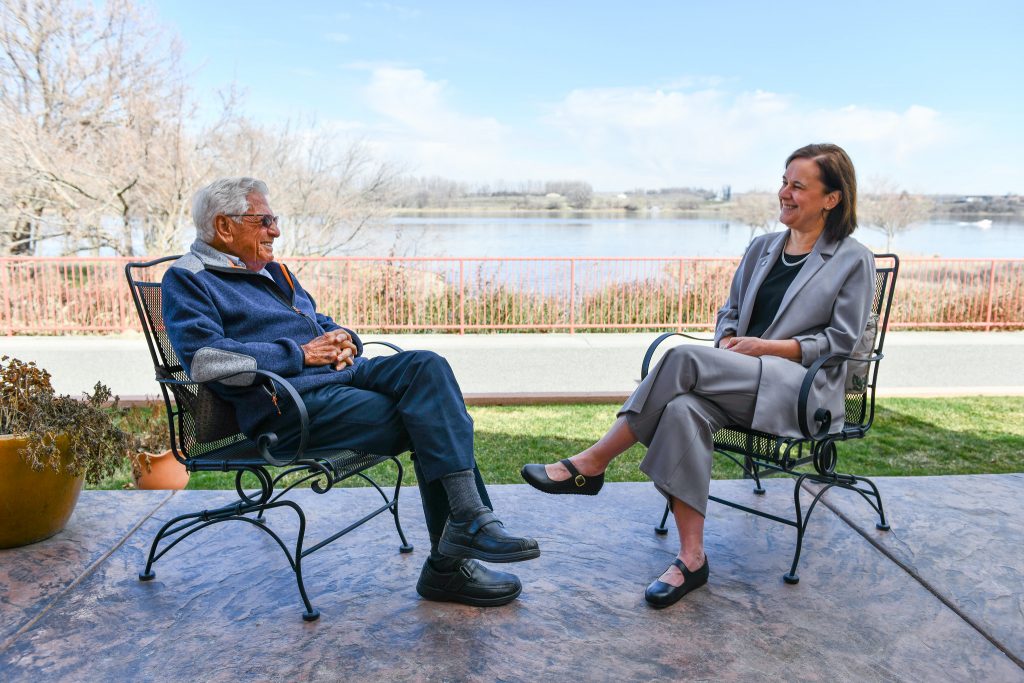
When the Chancellor of WSU Tri-Cities gave a talk at Rotary, little did she know that a brief mention of WSU’s renowned ice cream shoppe would open the door to a $500,000 gift
In early 2018, shortly after Sandra Haynes took the helm as chancellor of WSU’s Tri-Cities campus, she was invited to speak at the Richland Rotary Club of Tri-Cities. As part of her presentation, she casually mentioned how much she would love to bring Ferdinand’s to the Tri-Cities in some way, shape, or form.
In the audience was retired nuclear physicist and longtime Tri-Citian Bob Ferguson, who wholeheartedly agreed. When the two of them were introduced, Ferguson led with Ferdinand’s.
“In typical Bob fashion,” Haynes recalls, “he offered a list of creative ideas” for how a local Ferdinand’s could be realized.
Their shared enthusiasm for WSU’s famous creamery has not resulted in a local storefront (yet!). But it proved to be a congenial conversation-starter that eventually led to an exploration of Ferguson’s other passions.
Chief among them is his vision for transforming the Tri-Cities area into a clean-energy, post-carbon research innovation and economic hub.
Over the following two years, discussions between Ferguson and WSU evolved and, in December 2020, he made a $500,000 gift to support WSU Tri-Cities’ first endowed faculty position in energy and environment.
This investment lays the groundwork for a world-class research institute that promises to transform not only the Tri-Cities region, but also the world’s collective energy future, as we look beyond fossil fuels to the development of sustainable energy sources.
“Affinity” and the Crosby Family Connection
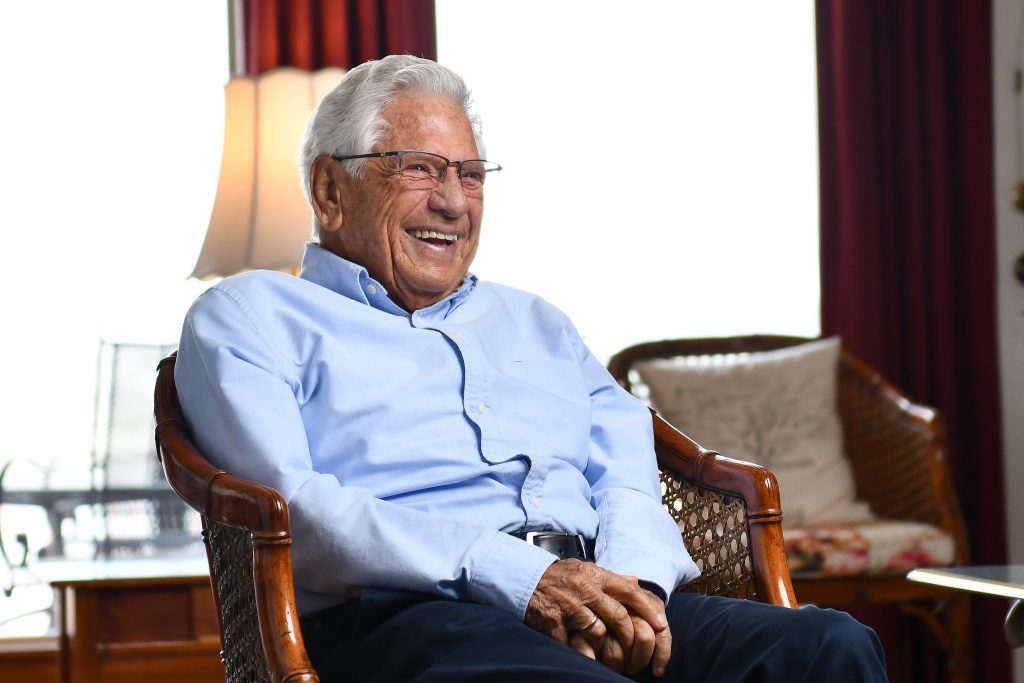
After making that initial Ferdinand’s connection, Haynes began to explore other ways of getting to know Ferguson’s many interests. She knew he had already endowed a scholarship at WSU Tri-Cities, named in memory of a fellow scientist, and wanted to find a way to build on this commitment.
She kept in touch with Bob regularly and attended his book-signing when he released a book he had written on the Hanford Site, where he had worked for many years. And she learned that he sponsored an Irish musical group, Affinity, to travel the Tri-Cities every year for a concert.
Affinity features an Irish harpist, pianist, and vocalist—with guest appearances by Howard Crosby, nephew of the legendary crooner, Bing Crosby, who grew up in Spokane. Howard Crosby is also the brother of the late Katie Crosby (Bing Crosby’s niece), who was Bob Ferguson’s wife for 62 years before her passing in 2018. In other words, Ferguson is part of extended Crosby family by marriage.
Ferguson asked Chancellor Haynes if WSU Tri-Cities might be able to host the Affinity concert in 2018; she was able to secure a performance space and the proceeds from the concert went to benefit WSU Tri-Cities. They immediately began planning the same arrangement for the following year.
This collaboration led to conversations about funding another scholarship, this time dedicated to supporting entrepreneurship, and Ferguson made that gift in 2019.
But Ferguson’s relationship with WSU accelerated to an entirely different level when he was introduced to Jaime Heppler, who joined WSU in mid-2019 as senior director of development for Tri-Cities.
And here’s where the Crosby connection comes into play in an entirely different way: Howard Crosby—Bob Ferguson’s brother-in-law—is a longtime family friend of the Heppler family (also from Spokane), and would sing Bing Crosby songs to Heppler when she was a child—and now sings to her children.
Whether it was the personal connection between their families, or perhaps the timing was just right, given all of the relationship-building that had come before, the early conversations between Heppler and Ferguson went straight to the core of the impact he most wants to make—on the Tri-Cities campus, on the region, and on the world’s energy future.
The “Bob Wall”
Ferguson’s storied career in nuclear energy began in 1957 at Hanford, where he was a physicist and operations supervisor at the B Reactor—the world’s first large-scale nuclear reactor, located in the Tri Cities. In 1978, he was appointed deputy assistant secretary of nuclear programs for the U.S. Department of Energy in Washington D.C., then in 1980 made his way back to the Tri Cities to serve as CEO for the Washington Public Power Supply System—now called Energy Northwest.
Ferguson’s deep history in the energy industry and extensive understanding of the unique confluence of energy resources in the Tri-Cities region—hydropower, wind, nuclear, and solar—has led him to envision an ambitious plan for further developing all of these resources in tandem, as a single integrated energy system.
During one of their first meetings, he sketched all of this out in elaborate detail on the whiteboard in Heppler’s office. This is now affectionately called “The Bob Wall.”
“Once he finished, I said ‘I’m never erasing this board,’” said Heppler. She immediately brought in Haynes to show her. “This is the vision.”
In fact, Ferguson’s vision aligned exactly with the direction WSU Tri-Cities had already determined it was heading.
“When setting the direction for this campus, we were inclusive of our stakeholders and listened to our community to determine their interests. We affirmed that the region is rich in energy research, production, innovation, and entrepreneurship,” says Haynes. “The Columbia and other rivers provide hydropower. Over 300 days of sun per year for solar energy, lots of wind, the only nuclear reactor in the Pacific Northwest, and a partnership with an on-campus laboratory with Pacific Northwest National Laboratory, where we conduct our biofuels research, rounds out the picture of the importance of energy in the region.”
The next step was to bring in Michael Wolcott, Regents Professor and Associate Vice President for Research at Washington State University.
Wolcott intently studied the “Bob Wall” and said to Heppler, “Gosh, you’ve really got something here.”
Ferguson and Wolcott were soon connected, scientist to scientist, to begin to clarify how Ferguson’s big ideas could begin to be operationalized. Wolcott’s involvement was also important as discussions of a transformative gift began to emerge.
True Credibility
“What Mike brought to the table was true credibility,” says Haynes. “Bringing donors together with those who have the technical expertise is an important part of fundraising. It helps to build confidence and momentum around an idea.”
Over the following months, as those discussions evolved, a proposal was developed—which included a three-page list of scientists throughout the WSU system whose work in energy research will be germane to the Tri-Cities initiative. This underscored the fact that, while Tri-Cities will be the geographic hub for the research institute, this will truly be a systemwide effort that taps expertise from WSU units all across the state.
The original proposal was presented in March 2020 and, after several revisions and modifications, Ferguson made his $500,000 gift in December of that year.
This is the latest chapter in Ferguson’s decades-long history with the campus. He was actively involved in early discussions regarding the expansion of the Tri Cities campus into a fully-fledged WSU campus in 1989.
“This gift is a culmination of the vision we had when we established WSU Tri Cities here,” he says.
Ferguson is now actively working his network of scientists and industry leaders, cultivating them as potential donors to build on his endowed gift. The goal is to reach $2 million, which will be the minimum required to launch the regional institute. He has hosted receptions on his balcony overlooking the Columbia River to talk up the possibilities of this investment, and will soon be hosting a river cruise for a prospective investor.
The conversation has come full circle with Rotary as well. Rotary wants to play a part in WSU Tri-Cities’ energy leadership, and is planning to plant carbon-capture trees on the Tri-Cities campus.
“Energy is the source of all economic development,” says Ferguson. “We need a curriculum. We need a workforce for the future. WSU Tri-Cities is uniquely positioned to integrate all these areas. WSU could lead this effort for the state and the nation.”
Key takeaways from the Ferguson gift story:
- You never know when a public talk or casual interaction might lead to something big. Make yourself visible, talk up your passion for WSU, see what happens.
- Be patient: Gradual steps may be the path to discovering great possibilities.
- Keep the connection active—small gestures can go a long way toward building a strong relationship.
- Get personal: Find out where meaningful person-to-person connections can be made.
- Bring in the right people at the right time, to establish credibility and confidence that the donor’s investment will be well-stewarded and lead to the intended impact.
- Think regional: In considering opportunities to build on this gift, who do you know who has a vested interest in the future of Tri-Cities?
- Think thematically: Who do you know who will resonate with the state, regional, and global impact of sustainable energy?
- Think reputationally: Who would want to support a marquee program that will distinguish WSU among its peers and beyond?
You can help us build the $2 million endowment to make Bob Ferguson’s vision a reality. Contact Jaime Heppler, jaime.heppler@wsu.edu