Volunteer Spotlight
Advocating for the Advocates
Story by Lisa Raleigh
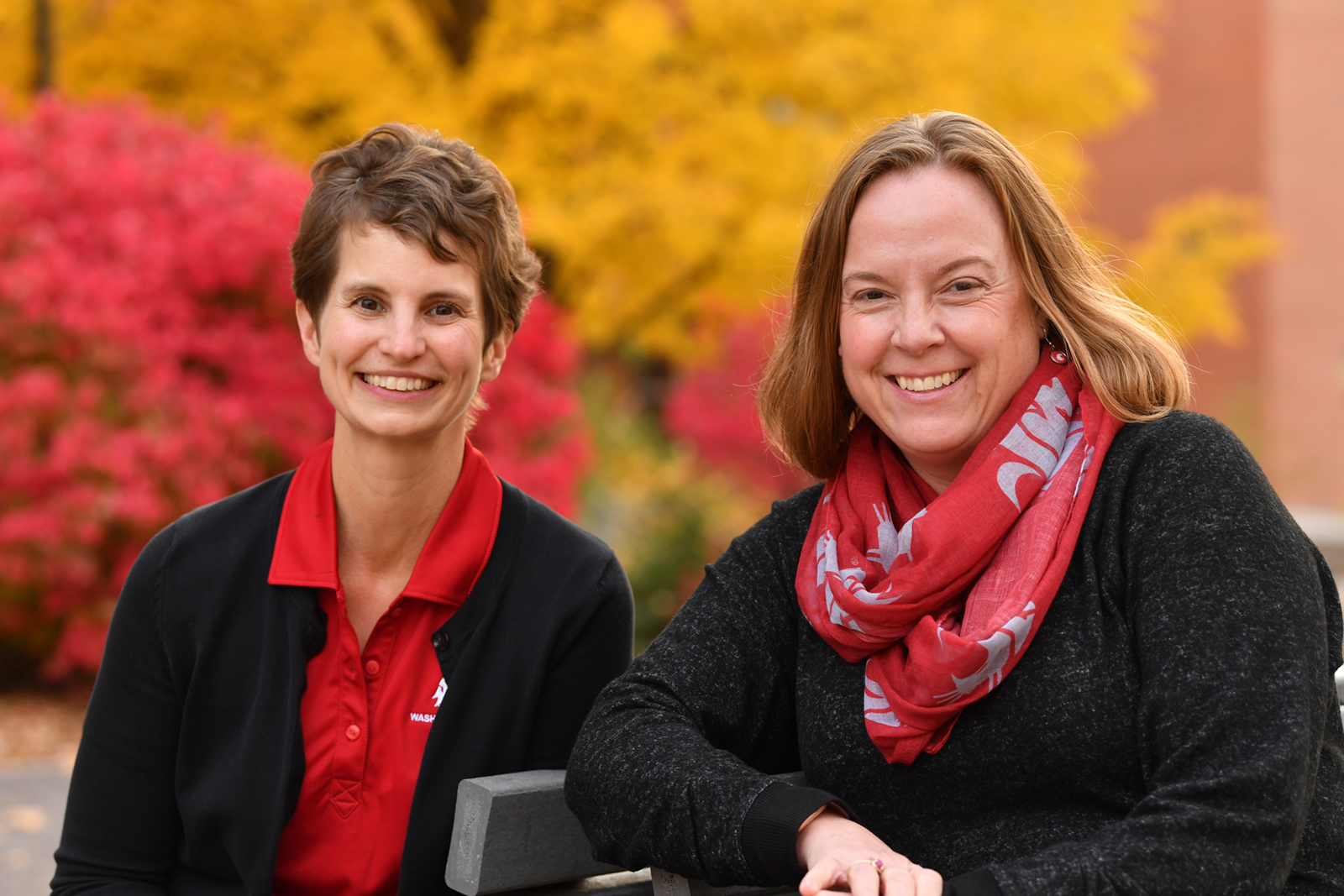
Rebecca Zanatta and Mandy Minick took completely different paths to the WSU Foundation Advocates and Advocates Emeriti.
Last summer, the WSUF appointed Rebecca Zanatta, ’97, (above right) as Chair of the WSUF Advocates, and Mandy Minick (left), a WSU Parent and Adopted Cougar, as Vice-Chair. They will serve in these inaugural positions until the end of 2022. During the Annual Fall Meeting in October 2021, in Pullman, they sat down to share their respective journeys to volunteer leadership, and their plans for setting into motion the work of the Advocates and Advocates Emeriti.
Q: The two of you have very different stories in terms of your engagement with WSU. How have your journeys led you to these leadership positions today?
Rebecca: For me, it’s full circle. I graduated from WSU with a degree in communication and a minor in business and leadership studies. My college job was working at Call-A-Coug, in the basement of the Alumni Center, calling alumni and parents and asking for money. Mike Connell was working for the Athletic Department at the time.
That’s when I learned that you can have a career in philanthropy. I’ve spent 25 years in nonprofit management and served in different roles. After graduating from WSU, I went on to get a master’s in higher-education administration from the University of Idaho. But I always knew I wanted to work on the external side of higher ed: alumni relations, fundraising, advancement. I did a summer internship in 2000 at WSU’s Seattle office, at a time when there were maybe three people who worked there. Then I went to Chicago from 2002 to 2006—and while there, helped get the local WSU Alumni Association chapter going; this was my first true experience as a volunteer for my alma mater. When I moved back to Seattle, there were three or four positions open for the WSU Foundation on the west side, and I was hired into one of them, working out of the Seattle office and helping build a regional development program from 2006 until 2010.
After that, I took a bit of a break. But then I got a call to join the Foundation Board of Trustees (now Advocates). My mentor was Laurie Johnson, who at the time was also a Trustee, and she welcomed me in. But that first meeting was a little odd because suddenly I was sitting around the table with people who I once saw from a distance as a student and staff member, but now they were my peers, my colleagues. Fast forward to be sitting around this table, at this Board of Directors meeting [as Advocates Chair, Rebecca is an ex officio member of the board and attended the Fall board meeting], and it’s a bit surreal and exciting.
Q: So, you’re now in the room where it happens.
Rebecca: Yes, for sure. Hamilton is one of my favorites.
Q: Mandy, you’re not an alum, how did you get connected?
Mandy: I grew up in western Washington and spent a lot of time coming to WSU as a high schooler, going to FFA conventions. But I decided I didn’t want to go to college with all the people that I went to high school with. So, I went to Cal Poly Pomona, right outside of Los Angeles, and got an agribusiness degree there. But I didn’t want to live in California forever, and came back to Washington to start my career with Northwest Farm Credit Services.
I knew I wanted to work with farmers and rural communities, and wanted to be closer to the production side of ag than the marketing side. Northwest is a cooperative—we’re owned by our borrowers—so everything that we do is to promote their success. And when we’re successful, we give them money back. In this sense, my work directly relates to land-grant values.
While I was establishing my career, I got married to a farmer—who’s both a Coug and a wine grower; he raised wine grapes for most of his life. We lived in Prosser, in the Tri-Cities area, where WSU has the biggest irrigated research center in the world, and we started coming to Pullman for football games. We also started giving to CAHNRS and the viticulture program, and got to know Linda Bailey, who was the fundraiser for CAHNRS at the time [now retired] and still lives here on the Palouse.
One day Linda asked if I wanted to be part of the Trustees, and it coincided with my being honored as an Adopted Coug. I joined the Trustees, attended a Fall Meeting and then 2020 came along, and the rest has been Zoom meetings, as both a Trustee and now an Advocate—that is, until this fall, with our 2021 Annual Fall Meeting in person.
Q: How did your participation as Trustees lead you to these leadership positions?
Mandy: Because Rebecca and I were both on the Trustee Engagement Task Force [TETF]—we served on both the first and second phases—we’ve been involved in the process of defining what Advocates and Advocates Emeriti leadership can and should look like. In other words, we have a good idea of not only the things that we want to accomplish, but also the background around why these things will be important, why they got pushed forward.
Our work together on the TETF was really organized around a big question: Here’s a group of people who want to do good things—but how does the individual volunteer make an impact, given they are part of a big organization? What is needed from them to move the university and the Foundation forward? What specific things need to be done? And mapped to that: What skills do they have?
Rebecca: Engagement is individualized for each person. You can talk to five different people who have five different ideas on what the word “engaged” means. I think it’s our job—Mandy’s and mine—in the next 18 months to define the different opportunities for Advocates and Advocates Emeriti engagement. This might be through one of the new Advocates Task Forces, serving on college advisory boards, making a gift, visiting a regional campus, posting on social media platforms and using your voice on behalf of WSU. This is the heart of the transition from having been Trustees, and no longer having a fiduciary responsibility, to becoming Advocates and having a clear understanding of what that means.
Mandy: And while engagement has to be personal, if you’re not engaging in something that the Foundation needs, it ends up being disengaging. No one wants to do a bunch of work as a volunteer if it doesn’t move things forward.
Rebecca: That’s why we constantly asked, as we were forming this new body: What does the Foundation need? The goals and objectives that we’re putting together for the Advocates Task Forces came out of surveys and also out of conversations in Spring Meeting, but they also reflect what the university and Foundation leadership feel is going to be helpful. Because if it’s not, no one wants to show up and not feel valued.
Q: How do you see your roles in this evolution?
Rebecca: We represent the Advocates; we are here to help define the path together. We want to know their thoughts, their ideas. We need to continue to have conversations with people and hear what their expectations are. There may be times when people might decide to step off, because they may feel that this isn’t what they signed up for, say, three years ago, and that’s okay. But I think we can be even more clear about what the expectations and opportunities will be. Thinking about it from the leadership view, we have talked to many individuals, we are bringing forward those different voices, and at the same time we bring in the perspective of Foundation leadership—to be intentional about how these two things come together.
Q: What would you like the Advocates and Advocates Emeriti to know about how you’re thinking about leading this group and how you see them participating?
Mandy: As a group, the Advocates want to work together to push forward the initiatives that are important to the Foundation and the university. But if there’s something that you’re good at—that you can do at your local campus, or with another interested party, alumni or not—and it supports the Foundation’s mission, then do it. It all comes back to one person at a time, those personal connections. Help with the group where you can, but if you’ve got a great idea that you can initiate and pursue yourself, then go for it.
Rebecca: I agree. Again, it goes back to that personalization. We are learning more about the mission, vision, and values of the Foundation, and we have heard President Schulz speak about OneWSU—and we will all be hearing much more about both of those larger goals. So, I would echo what Mandy said: How do you see yourself in the bigger picture and where can you support it? If we all know where we’re headed, we can each pick something that’s valuable and meaningful to us, and then we’re contributing to the overall goal of advancing the mission of the university and the culture of philanthropy for the Foundation. We can provide engagement ideas, but you can ultimately decide what you have time and passion to commit to.
Q: It sounds like you will be striking a balance between creating a framework for those who want or need it, while also welcoming individual efforts for those who have relevant, independent ideas?
Rebecca: Any time you allow for individualization, you open up a window for someone to be disappointed and not meet their expectations. So, we will be continually aware of that balance. Mandy and I have stepped into this role to be catalysts or instigators or project managers until December 2022, and we’re all going to learn together as we work towards defining both long- and short-term goals. We might end up with a 10-year plan but, while it’s ultimately about the long game, now is the time to start accomplishing a few things. We’ve been talking about this for a long time. And why would you volunteer for something if all we do is talk about it, and then six months later, we talk about it some more. The first things out of the gate need to be more tactical—things that can be accomplished by the April meeting, that then help us map out where we want to be by December 2022, and beyond.
Mandy: This is such a large enterprise and we have so many folks who all want to do good things. Which makes it very complex. Communication will be key. One of our new Task Forces is centered around this theme.
Q: Thinking about your own experience as a volunteer—what’s been really rich for you and what has resonated with you as a volunteer?
Rebecca: I really appreciate all the different kinds of roles I’ve had with the university—as a student, as an alum, as a staff member, as a volunteer, and now in a volunteer leadership role and having a seat at the table, being able to influence conversations. But also, being educated, learning about what this amazing institution is doing for others. I care so deeply about my alma mater and, as a volunteer and a leader, that’s a big part of my job—learning and absorbing, figuring out where my voice is connected to what we’re doing so that I can support the university. That’s a big thing for me—to feel connected, to be involved in those conversations.
Mandy: Agreed. I like to be able to see the fruits of my labor. Whenever we get to hear from students about the impact we’ve had, that’s just really gratifying. Also, the connectivity with university leadership is very motivating, keeps reminding me that this is a place where I want to give my time.
Rebecca: Most importantly, it’s about channeling our passion for something we care about—whether you’re an alum or non-alum. People want to be part of something meaningful. So, our job is figuring out ways that people can be invited into that—namely, getting deeply connected to what our job is as Advocates is to bring WSU to people and communities, to share the stories.